Home › Grade 5 › Reading & Writing
Summarizing: Main Idea in a Nutshell
Grade 5 reading & writing worksheet: Distilling multi-paragraph passages into concise main-idea summaries — 8 problems. No answer key — none needed for this sheet. Practice boiling multi-paragraph passages down to clear main-idea summaries. 8 passages with summary practice.
8 problems · Difficulty: medium
📝 No answer key included · ✅ Free for home & classroom use
Preview

The free PDF includes all 7 pages.
Highlights
- Grade
- Grade 5
- Subject
- Reading & Writing
- Pages
- 7 · worksheet
- Answer key
- None — no key needed
What's inside
- 1. Butterflies are insects that go through one of the most remarkable transformations in nature. This process, called metamorphosis, has four distinct stages. It begins when a female butterfly lays tiny eggs on the leaves of a host plant. Each egg is no bigger than the head of a pin, but inside, a caterpillar is forming. After about a week, the egg hatches and a hungry caterpillar emerges. The caterpillar spends the next few weeks eating leaves and growing rapidly, shedding its skin several times as it gets bigger. When it is fully grown, the caterpillar attaches itself to a stem and forms a chrysalis, a hard protective case. Inside the chrysalis, the caterpillar's body completely rebuilds itself. Finally, after one to two weeks, a butterfly with damp, folded wings pushes its way out. It pumps fluid into its wings to expand them, rests until they dry, and then flies away to start the cycle again. Write your summary:
- 2. Deserts are among the driest places on Earth, receiving less than ten inches of rain in a typical year. With so little water, daytime temperatures can soar above 100 degrees, while nights may turn surprisingly cold. Few places seem less welcoming to life, yet deserts are full of plants and animals that have found clever ways to survive. Desert plants have adaptations for holding on to every drop of water. Cacti store water in their thick, fleshy stems and have a waxy coating that slows evaporation. Their sharp spines are actually modified leaves that protect the plant from thirsty animals. Desert animals cope in their own ways. Many, like the kangaroo rat, are nocturnal, sleeping in cool burrows during the heat of the day and coming out at night to search for seeds. The kangaroo rat gets nearly all the water it needs from the dry seeds it eats and can survive without ever taking a drink. Write your summary:
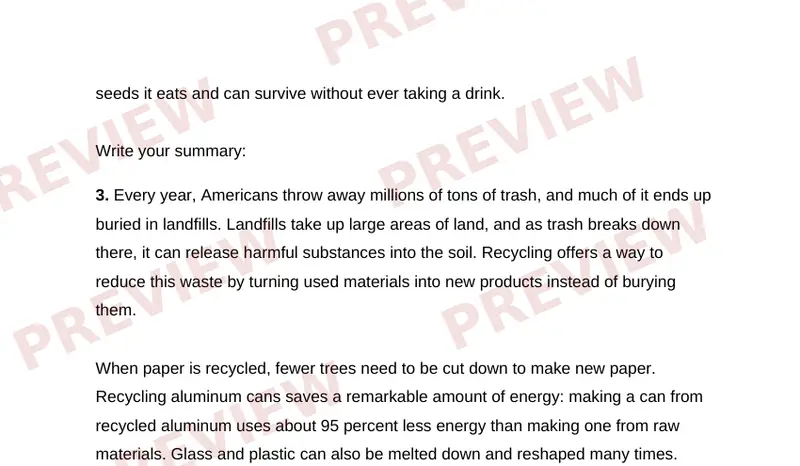
- 3. Every year, Americans throw away millions of tons of trash, and much of it ends up buried in landfills. Landfills take up large areas of land, and as trash breaks down there, it can release harmful substances into the soil. Recycling offers a way to reduce this waste by turning used materials into new products instead of burying them. When paper is recycled, fewer trees need to be cut down to make new paper. Recycling aluminum cans saves a remarkable amount of energy: making a can from recycled aluminum uses about 95 percent less energy than making one from raw materials. Glass and plastic can also be melted down and reshaped many times. Communities that run curbside recycling programs give residents bins for sorting paper, cans, and bottles, and trucks carry these materials to facilities where they are cleaned and processed for reuse. Write your summary:
- 4. Honeybees live in large colonies that may contain 50,000 or more bees, most of them female workers. Each worker has a job: some care for the young, some guard the entrance, and others fly out to gather food. Foragers visit flowers to collect nectar, a sweet liquid they carry home in a special stomach. Back at the hive, they pass the nectar to other workers, who fan it with their wings until most of the water evaporates and it thickens into honey. As bees move from flower to flower, pollen grains stick to their fuzzy bodies and rub off on the next blossom. This accidental delivery, called pollination, allows many plants to produce fruits and seeds. About one-third of the crops people eat, including apples, almonds, and blueberries, depend on bee pollination. In recent years, beekeepers have reported serious losses in their hives, caused by a combination of parasites, pesticides, and shrinking wildflower habitat. Write your summary:
- 5. More than 5,000 years ago, ancient Egyptians developed hieroglyphics, one of the world's earliest writing systems. The script used hundreds of picture-like symbols, and each symbol could stand for a sound, a word, or an idea. Scribes trained for years to master the symbols, then used them to record harvests, honor kings, and decorate the walls of temples and tombs. Egyptians wrote hieroglyphics with reed brushes and ink on papyrus, a paper-like material made from the pith of a river plant. They also carved the symbols deep into stone so their messages would last for centuries. When Egyptian civilization faded, the ability to read hieroglyphics faded with it, and for nearly 1,400 years no one could decipher the symbols. That changed in 1799, when French soldiers in Egypt uncovered a large black slab now called the Rosetta Stone. It carried the same decree in three scripts, including ancient Greek, which scholars could still read. By comparing the scripts line by line, scholars finally cracked the code of hieroglyphics. Write your summary:
- 6. Each year, one of the greatest wildlife spectacles on Earth unfolds across the grasslands of East Africa. More than 1.5 million wildebeest, along with hundreds of thousands of zebras and gazelles, set out on a giant circular journey. The herds are chasing the rains: where rain falls, fresh green grass sprouts, and the animals follow the food. The round trip covers roughly 1,800 miles and takes nearly the whole year. It is a dangerous march. The herds must cross rivers where crocodiles wait, and lions, hyenas, and leopards stalk the edges of the herd, targeting the young and the weak. Exhaustion and thirst claim many animals along the way. Yet the survivors press on, and their journey shapes the land itself: their grazing and droppings fertilize the soil, and their numbers feed a host of predators and scavengers. Write your summary:
Showing 6 of 8 sections. The free PDF includes all 8 sections.
Grade 5 reading & writing worksheet: Distilling multi-paragraph passages into concise main-idea summaries. 7 pages, 8 problems. No answer key — none needed for this sheet. Free printable PDF.
What’s included
- 8 problems across 7 pages
- Suggested use: literacy centers, homework, reading groups, or sub plans
Answer keys
No answer key — none needed for this sheet.
Format
PDF, print-and-go.
Classroom use
One license per teacher: print as many copies as you need for your own students and share through your class platform. Please don’t post the files publicly. License details.
Quick answers
What does this worksheet cover?
Grade 5 Reading & Writing — Distilling multi-paragraph passages into concise main-idea summaries.
How many problems are included?
8 problems.
Does it include an answer key?
No — no answer key is needed for this sheet.
Is this worksheet free?
Yes — it is a free printable PDF. Download it from the button above.
What format is the worksheet?
A printable PDF, 7 pages.
More grade 5 reading & writing worksheets

Comparing and Contrasting Texts
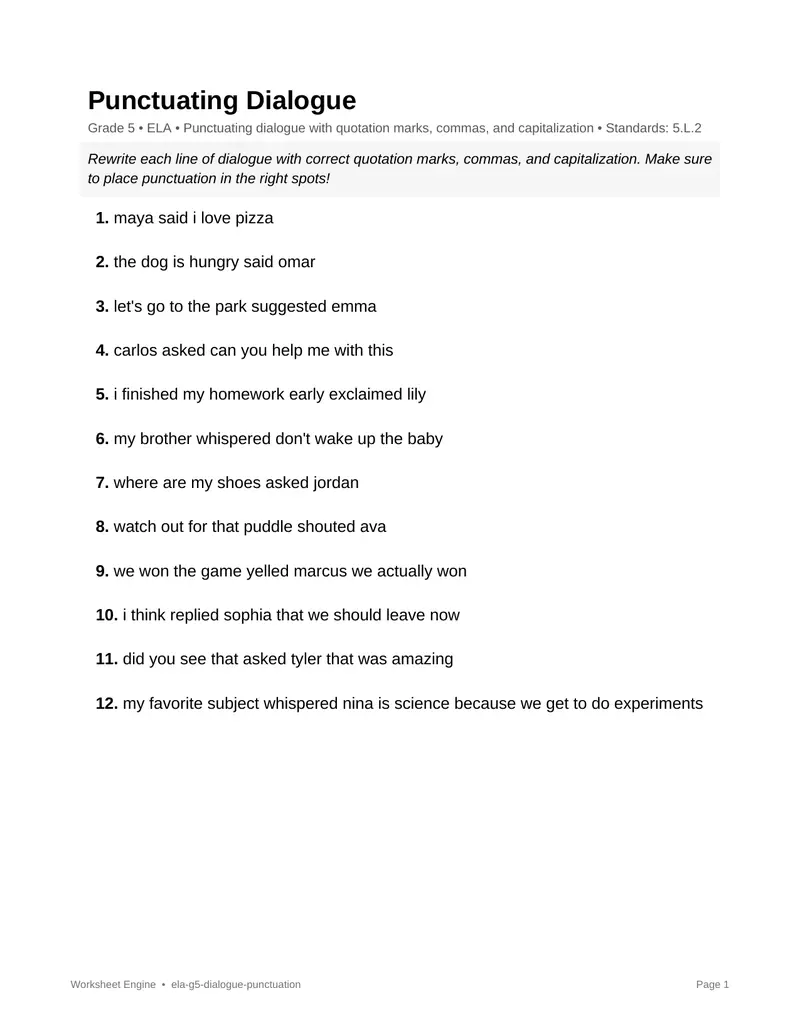
Punctuating Dialogue — Grade 5

Persuasive Paragraphs: State Your Case
