
Home › Topics › Telling Time Worksheets
Telling time worksheets
Telling time worksheets for reading analog clocks, time to five minutes, and elapsed time — printable PDFs with answer keys for grades 1–3.
How to teach telling time
Telling time is one of the first “real world” math skills kids use every day — and one of the trickiest to learn. Reading an analog clock asks a child to do several things at once: remember that the short hand means hours and the long hand means minutes, count by fives around the clock face, and understand that “half past” is the same as “:30.”
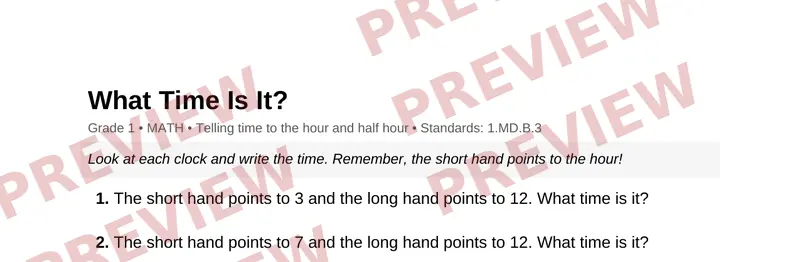
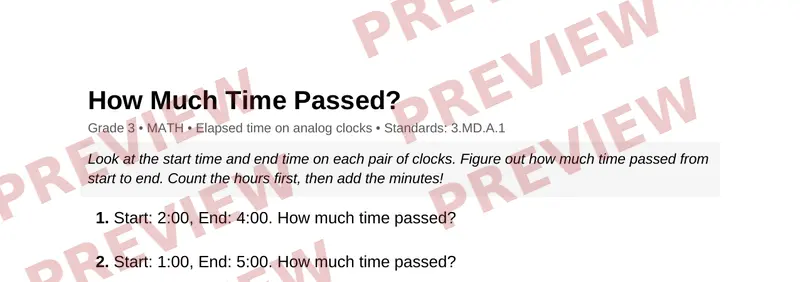
The progression that works: start with time to the hour, then the half hour, then the quarter hour. Once those are solid, introduce counting by fives and time to five minutes. Elapsed time — “how much time passed between 2:15 and 3:45?” — comes last, because it combines clock reading with subtraction across the hour. The worksheets below follow that progression, and each one ships with an answer key so checking work takes minutes.
A few things that help at home: keep an analog clock where your child can see it, narrate the time out loud (“it’s twenty-five past four — time to start homework”), and let them be the family’s timekeeper for cooking timers and car rides. Ten minutes of daily practice beats an hour once a week.
Telling Time Worksheets


Telling Time Worksheets FAQ
At what age should kids learn to tell time?
Most children start with time to the hour and half hour in first grade (around ages 6–7), move to five-minute intervals in second grade, and tackle elapsed time in third grade. If your child is still shaky on the basics, back up a step — clock skills build directly on each other.
Should kids learn analog or digital clocks first?
Analog first. An analog clock shows time as a quantity you can see — the space between numbers, the sweep of the minute hand — which builds number sense a digital readout can’t. Digital time is easy to pick up once analog makes sense.
What is the hardest part of telling time?
Elapsed time. Figuring out “how much time passed” requires reading two clocks and subtracting across the hour boundary — really a word problem in disguise. Practice it on a number line or an open timeline before doing it purely in your head.
How much practice does telling time take?
A little every day. Five to ten minutes of clock reading — on worksheets, a wall clock, or a wristwatch — builds the skill far faster than one long weekly session.