
Home › Topics › Decimals Worksheets
Decimals worksheets
Decimals worksheets: reading and writing decimals, comparing, and all four operations — printable PDFs with answer keys for grades 4–5, free and paid.
How to teach decimals
Decimals are just fractions wearing a different outfit — and telling kids that upfront saves a lot of confusion. 0.5 is 1/2, 0.25 is 1/4, and the place-value system they already know (ones, tens, hundreds) simply extends to the right of the decimal point (tenths, hundredths). Once that clicks, decimals feel like an extension, not a new topic.
Start with reading and writing decimals to tenths and hundredths, then comparing and ordering — the classic trap is thinking 0.45 > 0.5 because 45 > 5. Money is the perfect manipulative here: $0.50 vs $0.45 settles the argument instantly. Then move to the four operations, where lining up the decimal point (for addition and subtraction) is the whole game.
Connect decimals to the real world constantly — prices, measurements, sports stats, weather temperatures. Decimals are the most “everyday” topic in elementary math, and kids who see them on price tags and thermometers learn them faster.
Decimals Worksheets


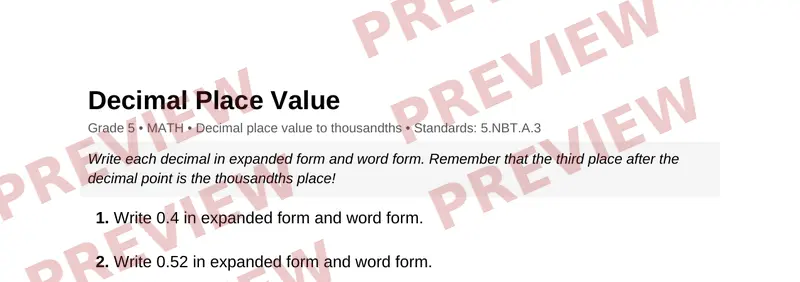

Free worksheets
Start here — no purchase needed.
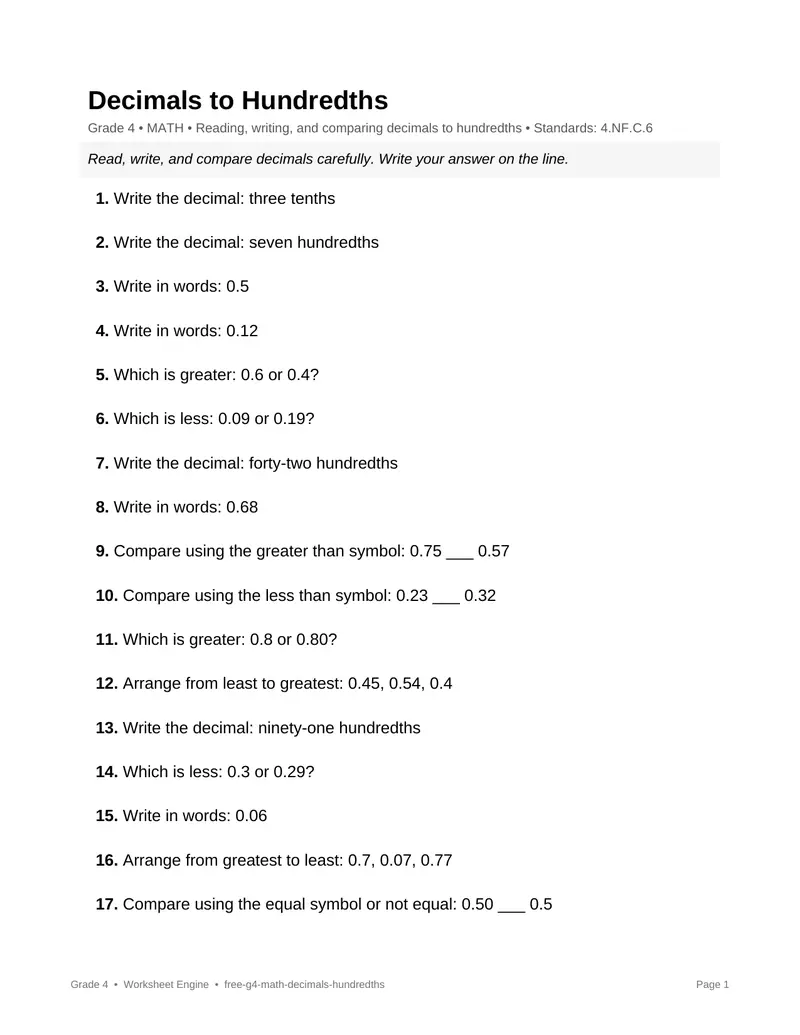
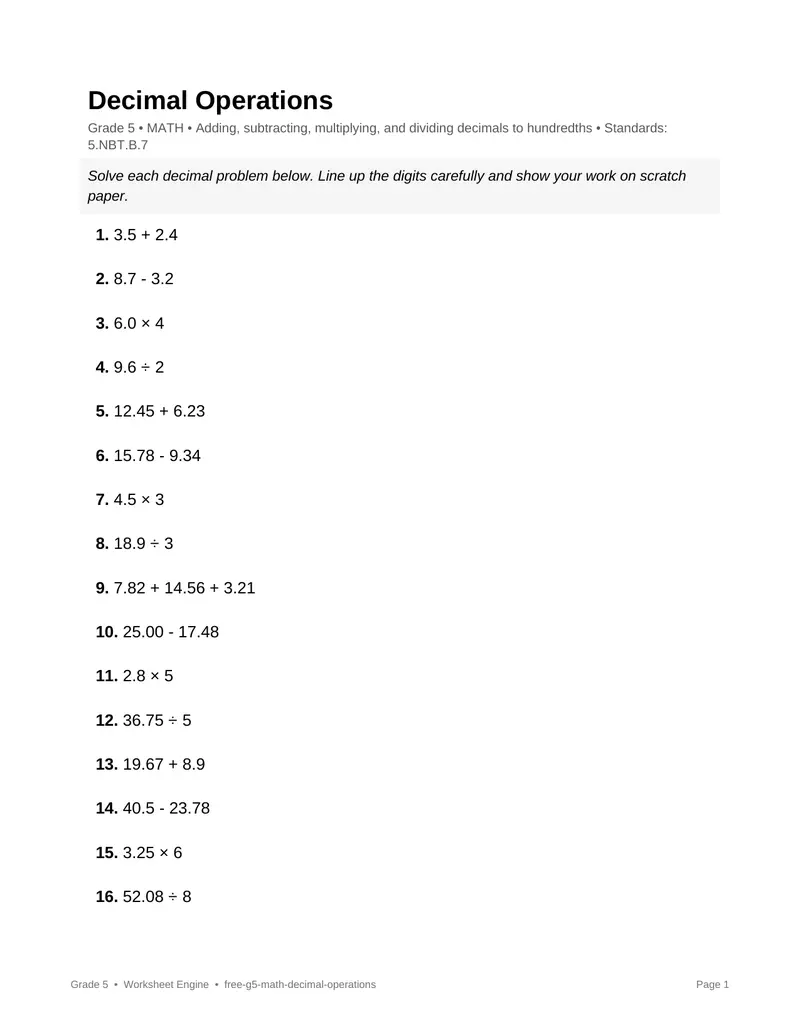
Decimals Worksheets FAQ
What is the connection between decimals and fractions?
They’re two notations for the same numbers: 0.5 = 1/2, 0.25 = 1/4, 0.75 = 3/4. Kids who can convert between the two fluently understand both better — it’s the same quantity in different clothes.
Why do kids think 0.45 is bigger than 0.5?
They’re applying whole-number logic (45 > 5) to the digits after the point. The fix: compare place by place from left to right (tenths first: 4 tenths vs 5 tenths), or use money — nobody thinks 45 cents beats 50 cents.
When adding decimals, why line up the decimal point?
Because you can only add like place values — tenths to tenths, hundredths to hundredths — just like you line up ones with ones in whole-number addition. The decimal point is the anchor that keeps every digit in its place.
When do kids learn decimals?
Usually introduced in 4th grade (tenths and hundredths) with full operations in 5th grade. A shaky grasp of fractions or place value will show up here first, so it’s worth shoring up those foundations.